
If your patio has slabs that rock, joints that have opened up, puddles that never drain or a green film that comes back every winter, you're not alone — it's the most common thing we're called out to in mid-Essex. Almost always the cause is the same, and it's not the slabs.
The ground under mid-Essex
Much of mid-Essex — Chelmsford, Witham, Hatfield Peverel, Braintree and up through Terling to Gosfield — sits on heavy clay. Clay is a "shrink-swell" soil: it loses water and shrinks in dry summers (the 2022 drought opened up cracks you could put a hand in), then swells again through a wet winter. The ground surface can move by 25 mm or more over a year, and anything sitting on it moves too.
Add a large tree or hedge nearby drawing water out of the clay, and the movement is greater still on that side of the garden — which is why one end of a patio often drops more than the other.
What that does to a patio laid on the cheap
A lot of patios in Essex — including on new-build estates — were laid straight onto sand, or onto a couple of inches of hardcore, with each slab sitting on five blobs of mortar ("dot and dab", or spot bedding). It's fast and it looks fine on the day. Then:
- The clay moves and the thin base moves with it. Slabs tilt and start to rock.
- Water gets under the spot-bedded slabs and the voids fill with silt. Slabs go hollow, then crack.
- Joints open, weeds get in, and ants excavate the sand bedding from underneath.
- Falls disappear as the patio settles, so rain sits on the surface instead of running off.
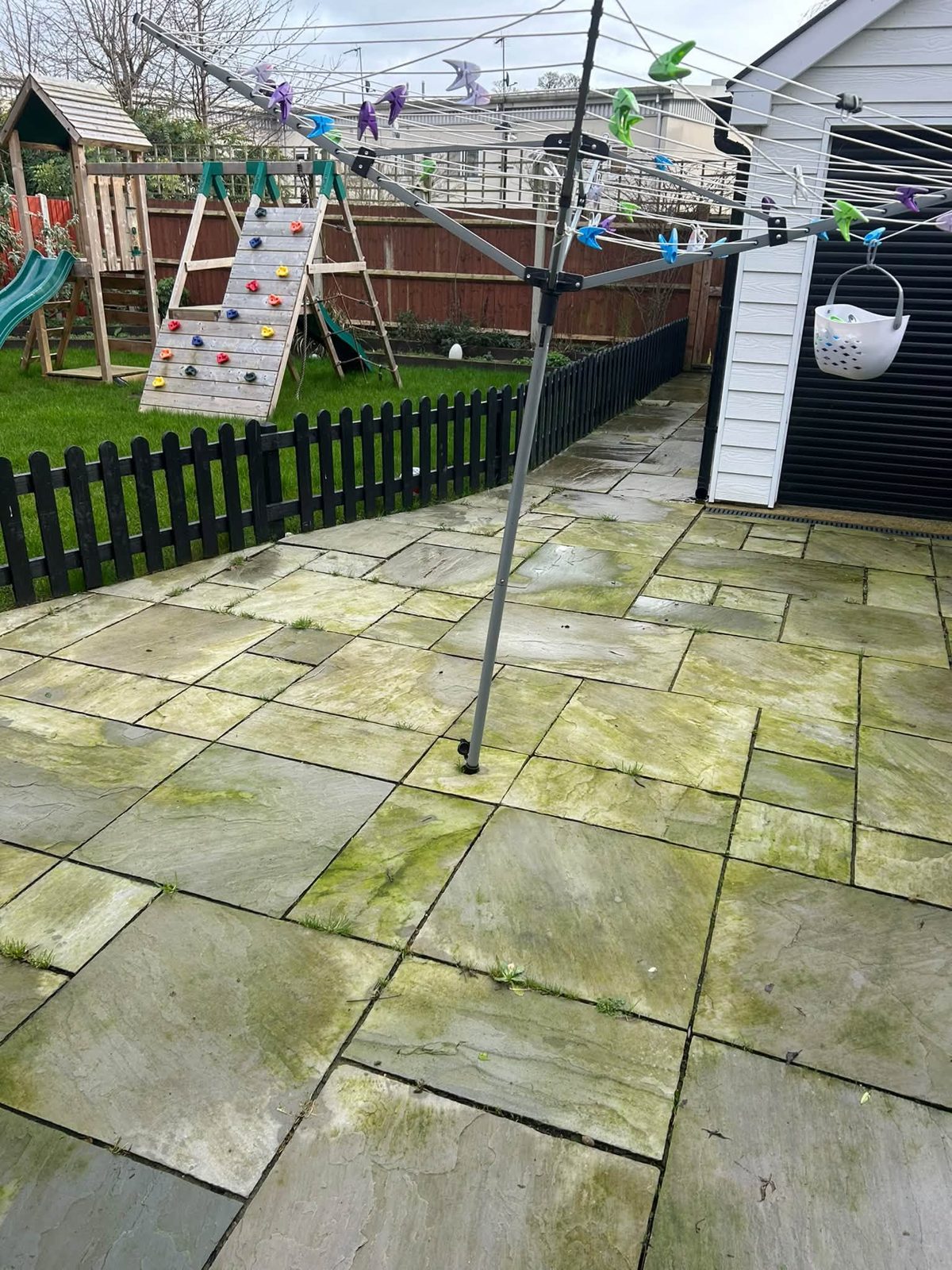
Why it goes green
Algae and moss need two things: shade and standing water. Once a patio has lost its fall, or the joints have sunk into little channels, every wet spell leaves a film of water on the surface and the green comes back no matter how many times it's pressure-washed. Sandstone and concrete slabs are porous, so they hold that moisture too. The cleaning isn't the fix — it's the drainage.
Restore or relay? How we decide
| What we find | What it needs |
|---|---|
| Slabs solid, falls still there, just green and grubby with tired joints | Restoration. Professional pressure clean, re-joint with a resin or two-part compound, treat and seal. Usually a single day — see our before & after jobs. |
| A few rocking slabs, rest sound | Lift and relay the affected slabs on a full mortar bed, then restore the rest. |
| Widespread rocking, cracked slabs, water pooling against the house | Relay the patio properly. The base has failed; anything else is money spent twice. |
What "properly" means on clay
- Excavate to the right depth — usually 200–250 mm below finished level, more on soft ground.
- Geotextile membrane to stop the sub-base pushing down into the clay.
- 100–150 mm of MOT Type 1, laid in layers and compacted with a plate compactor.
- Full mortar bed under every slab — no spot bedding — with a primer or SBR bond bridge, especially for porcelain.
- Falls of about 1 in 80 away from the house, and a finished level at least 150 mm below the damp-proof course.
- Somewhere for water to go — a channel drain or soakaway sized for clay, which drains slowly.
- Proper jointing with a resin or polymeric compound that stays put, not brushed-in sand.
Can I fix it myself?
Cleaning and re-jointing a sound patio is a reasonable weekend job with a hired pressure washer and a good jointing compound. Lifting and relaying slabs on a failed base isn't — without addressing the sub-base you'll be doing it again next year, and getting the falls right by eye is harder than it looks. If more than a handful of slabs are moving, get someone to look at it.
Frequently asked questions
How much movement is normal for a patio on clay?
None, if it's been built with a proper compacted sub-base. Seasonal ground movement is normal; a patio that follows it isn't. The sub-base is there precisely to spread the load and isolate the slabs from the clay.
Will sealing my patio stop it going green?
It helps — a good sealer stops the slabs absorbing water so algae has less to hold onto — but it won't fix standing water caused by lost falls. Sort the drainage first, then seal.
My new-build patio is already sinking. Is that normal?
Unfortunately common. Developer patios are often laid quickly on minimal base. If the house is still within its warranty period it's worth raising with the builder; otherwise it usually needs relaying.
How long does a patio restoration take?
A clean, re-joint and treat on a typical patio is a single day. Weather matters — jointing compounds need a dry surface — so we'll pick the day with you.
Got a patio that's seen better days?
We'll tell you straight whether it can be cleaned and re-jointed in a day, or whether the base has failed and it needs relaying. Free site visit across Essex, London and Devon.